> For the complete documentation index, see [llms.txt](https://sharwa.gitbook.io/sharwa-docs/llms.txt). Markdown versions of documentation pages are available by appending `.md` to page URLs; this page is available as [Markdown](https://sharwa.gitbook.io/sharwa-docs/guide/how-to-trade-on-sharwa-complete-guide.md).
# How to Trade on Sharwa: Complete Guide
What you'll learn: Create margin account, open leveraged positions, trade options, and earn yield.
### Before You Start
**You need:**
* Wallet with Arbitrum network (MetaMask, Rabby, WalletConnect)
* $10+ in USDC, ETH, or WBTC
**What you'll be able to do:**
* Use ETH as collateral to trade BTC (cross-asset)
* Open leveraged positions up to 10x
* Add options to prevent liquidation
* Provide liquidity and earn yield
## Step 1: Create Your Margin Account
1. Connect your wallet to [Sharwa.finance](https://sharwa.finance/).
2. Click "Create New Margin Account".
You'll see a feature overview popup.
Read it or skip – you can always come back to documentation.
## Step 2: Deposit Collateral
1. Select asset: USDC, ETH, or WBTC.
2. Sign 2 transactions:
1. Approve
2. Deposit into margin account
Now you can trade.
## Step 3: Understand your Margin Account
#### Account Info #1
* Margin Level: Your account health percentage. Must stay above 110% to open positions, above 105% to avoid liquidation. We use Chainlink Price Feeds to calcualte your margin level.
* Account Balance at Liquidation: Shows how much value you'd have left if liquidated now. Helps you see risk.
#### Balances #2
* Account Balance: Total value of your collateral right now plus unrealized PnL
* Unrealized P\&L: Profit or loss on open positions (not yet closed)
* Unsettled P\&L: Profit or loss from closed positions waiting to settle.
#### Collateral #3
Shows your deposited collateral. If you want to swap collateral just click "Swap".
#### Margin Account Positions #4
Lists all open positions:
* Leveraged long/short positions
* Options (puts and calls)
## Step 4: Start Trade
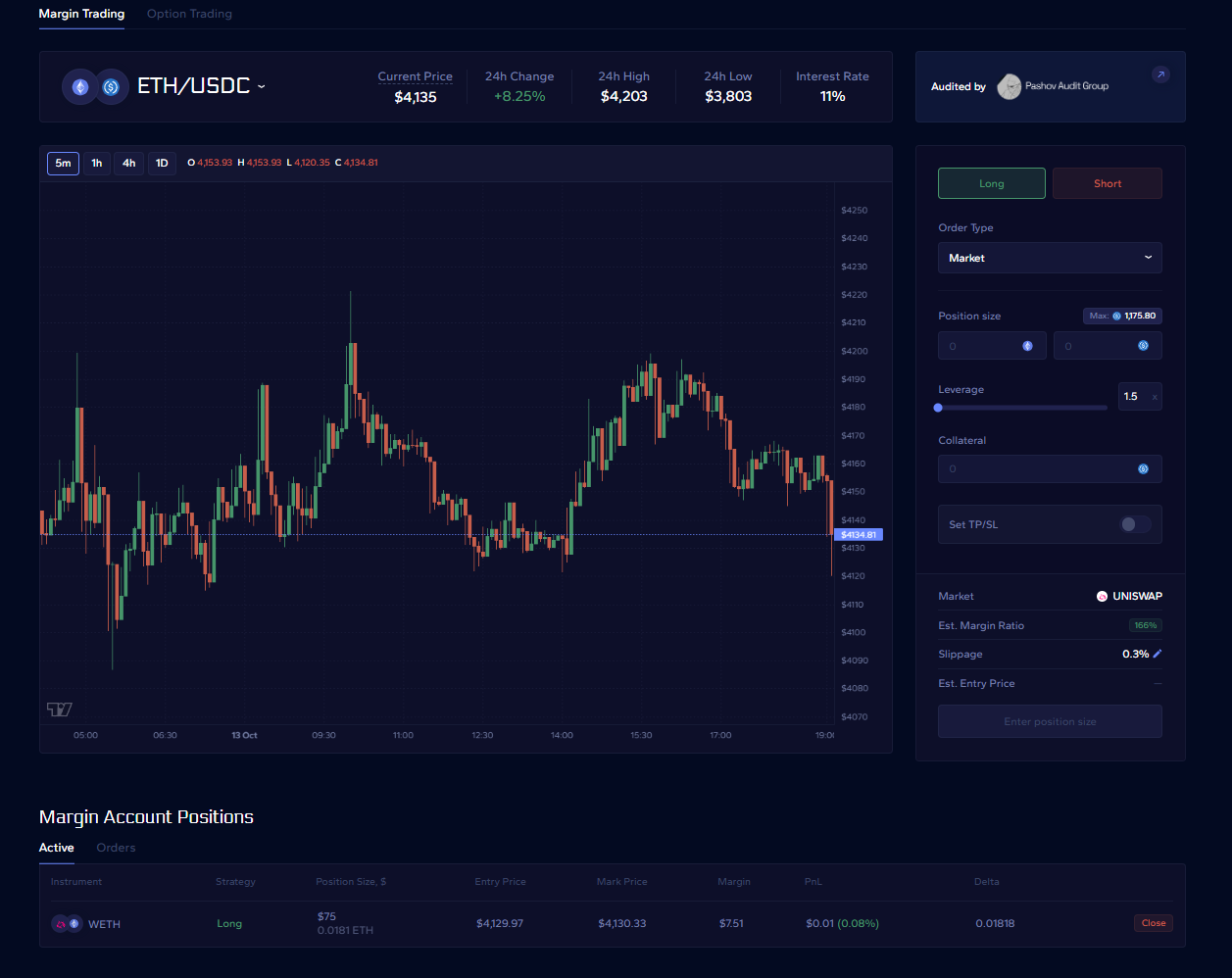
**To open a position:**
1. Select direction: Long or Short
2. Enter amount / select leverage
3. Show amount of margin reserved for this position
4. Projected margin ratio after the position will be opened
1. Check Projected Margin Ratio: Shows your new margin level after opening position.Requirements:
* Must be ≥110% to open
* Should keep ≥150% for safety
* Gets liquidated if drops to 105%
After a position is opened, it will appear under Margin Account Positions
* Mark Price: based on the Chainlink price feed.
* PnL columns do not include opening/closing fees or interest rates.
## Step 5: Options Trading
**🛡️Options prevent liquidation. You pay premium upfront, get insurance against crashes.**
You see the option chain – table of all available options with different strike prices and expiration dates.
**Select paratemers:**
1. Expiration Date (1 day or 3 day).
2. Direction:
* Call: Profit when price rises (protects shorts)
* Put: Profit when price drops (protects longs)
{% hint style="info" %}
You have long ETH position? Buy put option.
{% endhint %}
1. Enter amount of contracts that you want to purchase. 1 contract = 1 ETH of coverage.
2. Select Payment method:
1. USDC
2. ETH
3. WBTC
Check projected margin ratio after the position will be opened
* Must be ≥110% to open
* Should keep ≥150% for safety
* Gets liquidated if drops to 105%
If option is In The Money (ITM) at expiration, it exercises automatically 30 minutes before expiry. You get the profit added to your margin account balance in USDC.
## Step 6: Settling Your Account
### What is Unsettled P\&L?
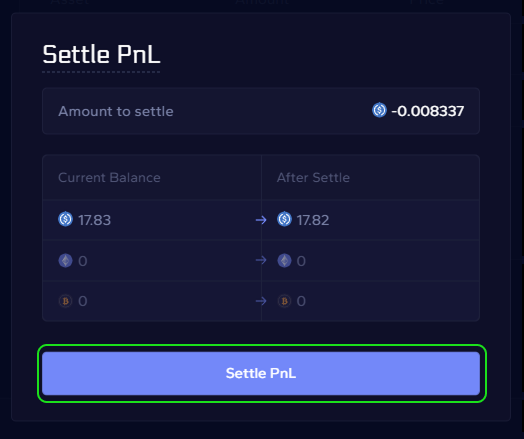
Trading fees that need final processing
### When to Settle
You closed all positions. Your account shows "Unsettled P\&L."Settle your account to withdraw all available collateral.
* Without settling: You can only withdraw part of your collateral.
* After settling: You can withdraw everything.
### How to Settle
1. Click "Settle Account" button.
2. Sign transaction
Your account processes all fees and updates your available balance.
#### Why Always Settle After Closing Positions
1. Restores margin level to infinity. No liquidation risk.
2. Frees all collateral. Nothing locked, ready to withdraw or trade again.
{% hint style="success" %}
> Always Settle your account after closing positions — it restores your margin level to infinity, removing any liquidation risk.
> {% endhint %}
## 7. Earn
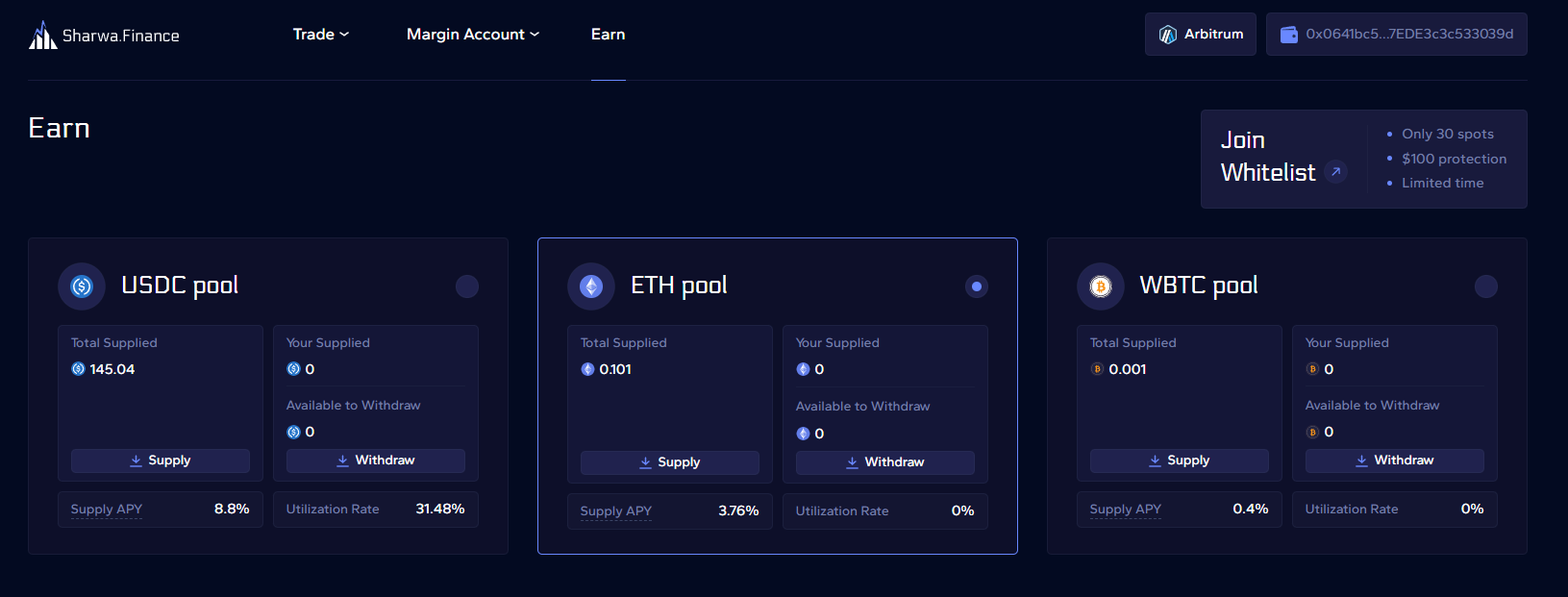
Earn passive yield by supplying assets to Sharwa liquidity pools.
### How It Works
Traders borrow from liquidity pools to open leveraged positions. You supply the assets. You earn the fees.
**Your role:**
1. Deposit USDC, ETH, or WBTC into a liquidity pool
2. Traders borrow from your pool for leverage
3. You earn borrowing fees automatically
4. Withdraw anytime (when pool has available liquidity)



.png?alt=media&token=d2b5ec7a-1f10-40bd-9baa-0f84ac526078)